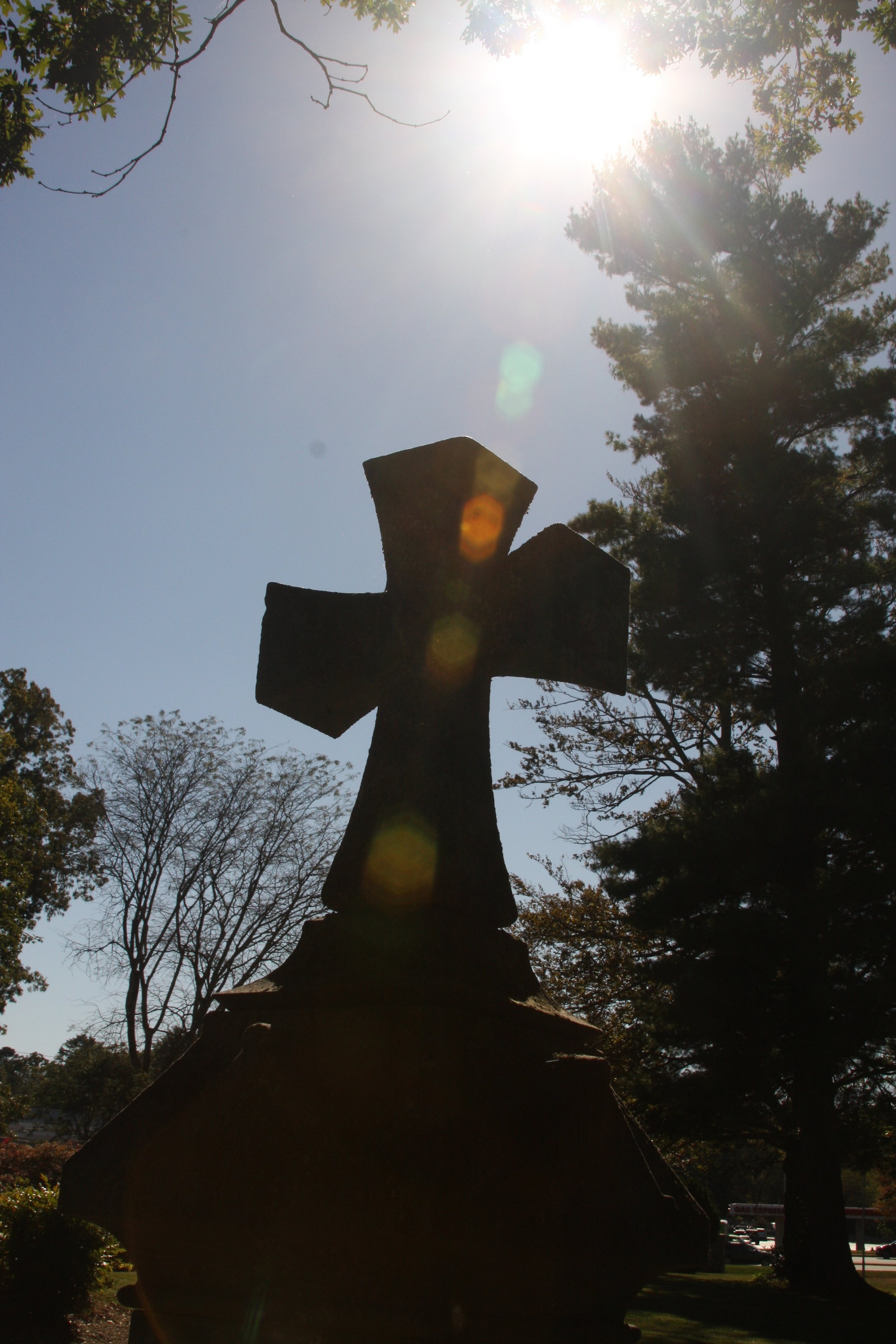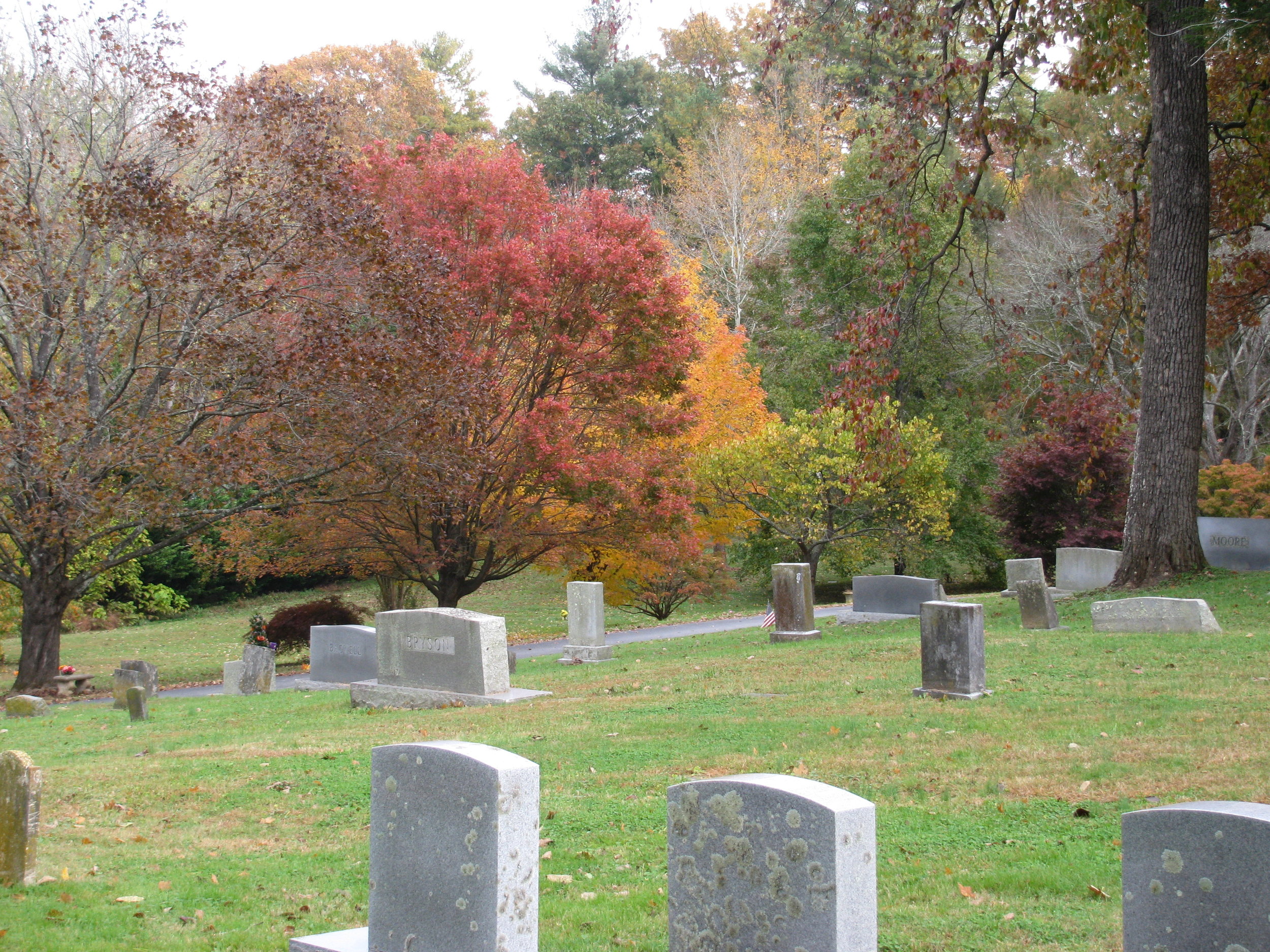
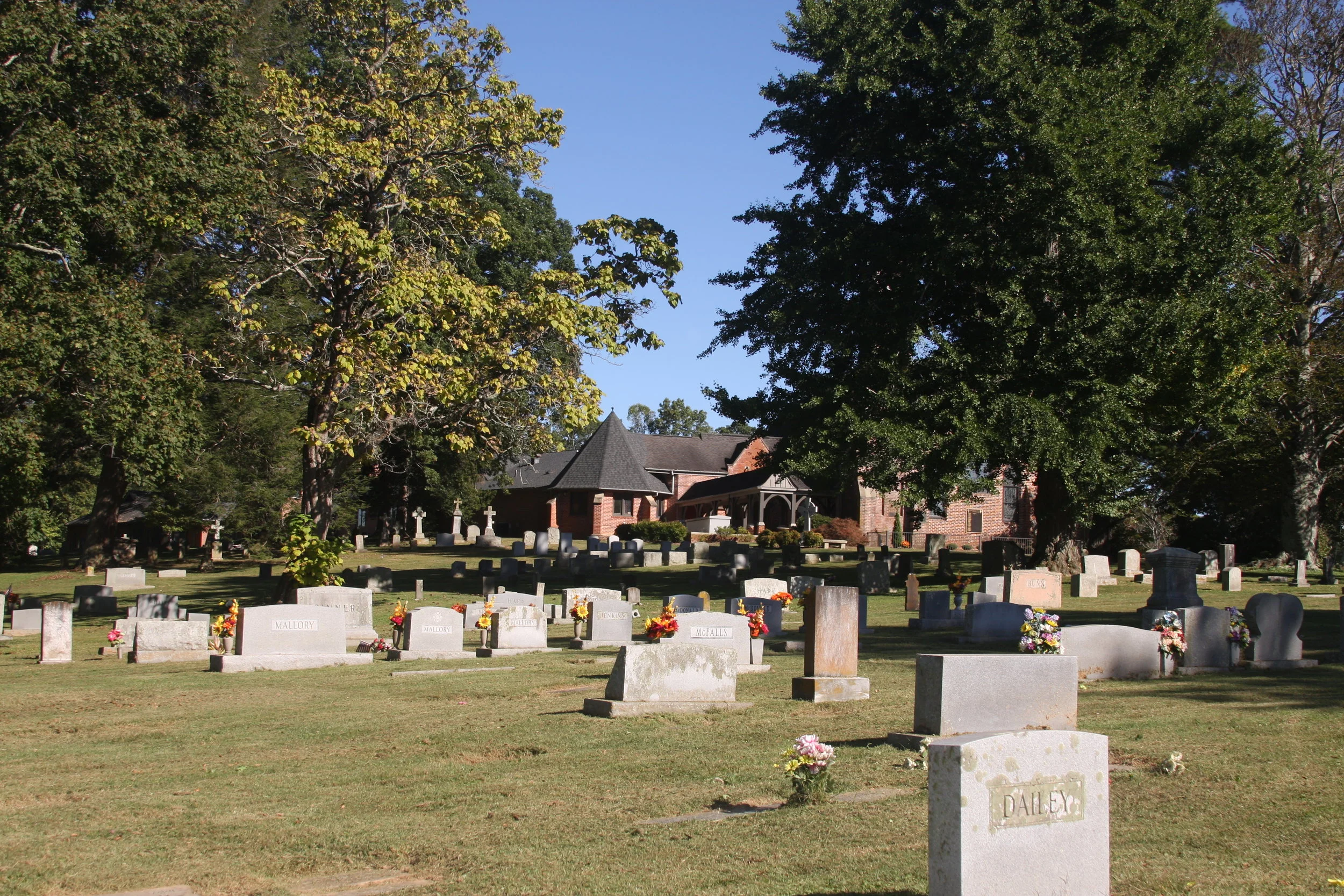
Calvary Churchyard has for many years operated as a public cemetery, and there are many grave spaces still available for sale.
Please call the parish office at 828.684.6266 or
email CHURCHYARD@calvaryfletcher.org to set
up an appointment to inquire about space.
Within the 20+ acres that comprises the Churchyard, burial spaces are available for sale in sections that allow for upright monuments, and even more are available in sections with markers that lie flat to the ground. These sections allow for both vault burials and cremated remains. There is a Memorial Garden situated against the western wall of the church building that is intended for the interment of ashes directly into the ground. We also offer a similar option in our Canterbury Memorial Garden. The Churchyard also offers columbarium interment of ashes which is located close to the church building itself, near the bell tower, where a mobility ramp has been recently installed. We are happy to meet with you in person, and ask that you call or email for an appointment so that we may schedule enough time to give your inquiry the time it deserves.
Calvary Church does maintain a database containing the names and locations of almost everyone buried in the Churchyard. If you would like to visit a specific grave, please email churchyard@calvaryfletcher.org with as much specific information as possible about the grave you are hoping to find. Please allow up to 5 days for responses to non-urgent inquiries.
* * *
September 2026 News: Reimagining Our Sacred Spaces in Calvary’s Prayer Labyrinth & Canterbury Memorial Garden
At Calvary, we are dedicated to nurturing places of quiet, peace, and spiritual reflection for our parish and community. Recently, our Prayer Labyrinth and Canterbury Memorial Garden have undergone meaningful changes to open and redefine these sacred spaces.
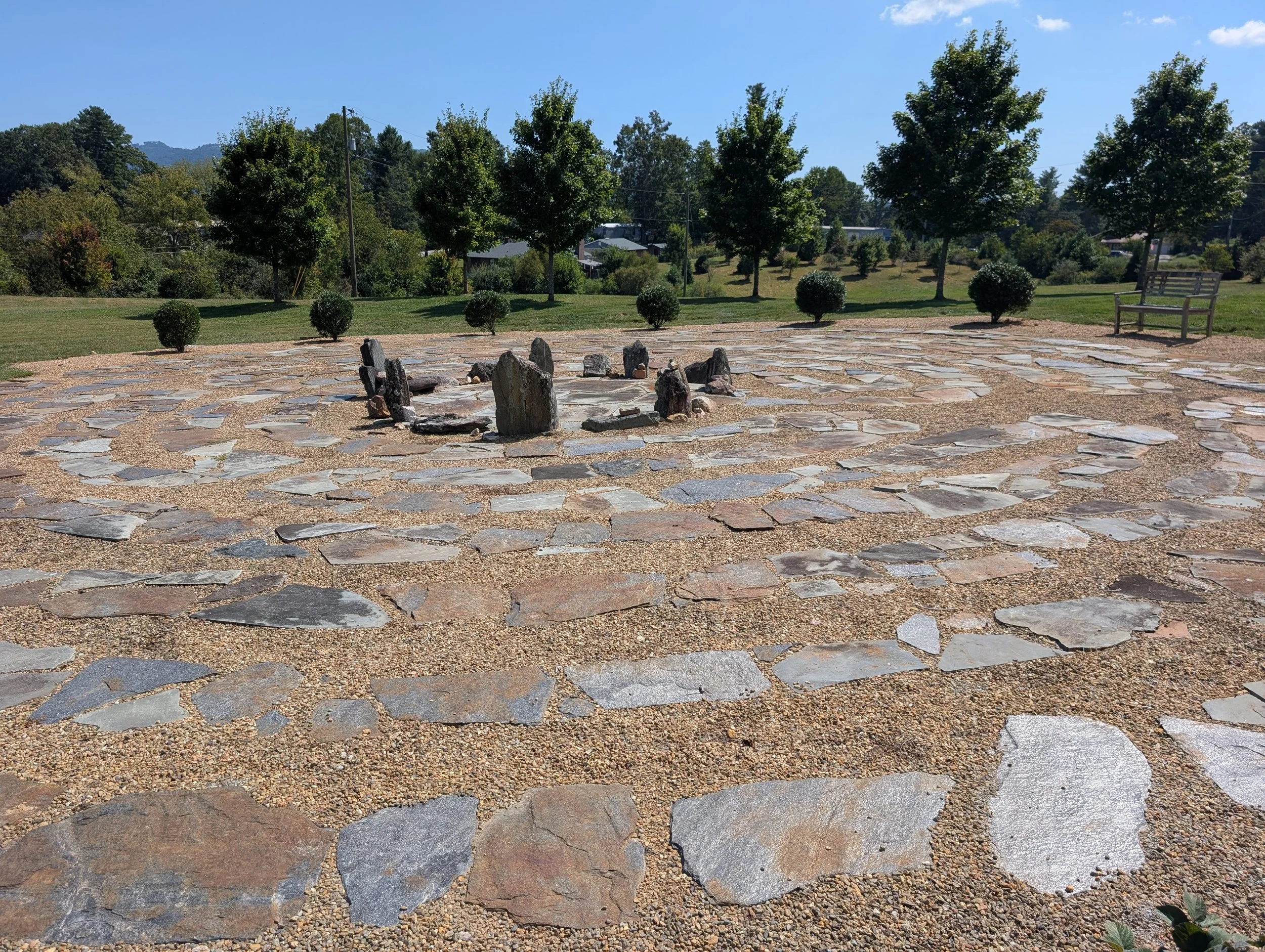
Calvary Labyrinth
To enhance the Prayer Labyrinth, pictured above, the large historical stones were thoughtfully relocated, opening up the path and creating an inviting space for prayerful, meditative walking. Other denominations in our community often reserve the Labyrinth for their prayer group walks and we are so thankful to share this welcoming haven with our fellow neighbors. A short walk from our Prayer Labyrinth, is the Canterbury Memorial Garden, pictured below. Diseased hemlocks were recently cleared to allow new growth and light into the landscape. To complete this transformation, beautiful iron fencing has been installed, gracefully framing and defining this memorial space.
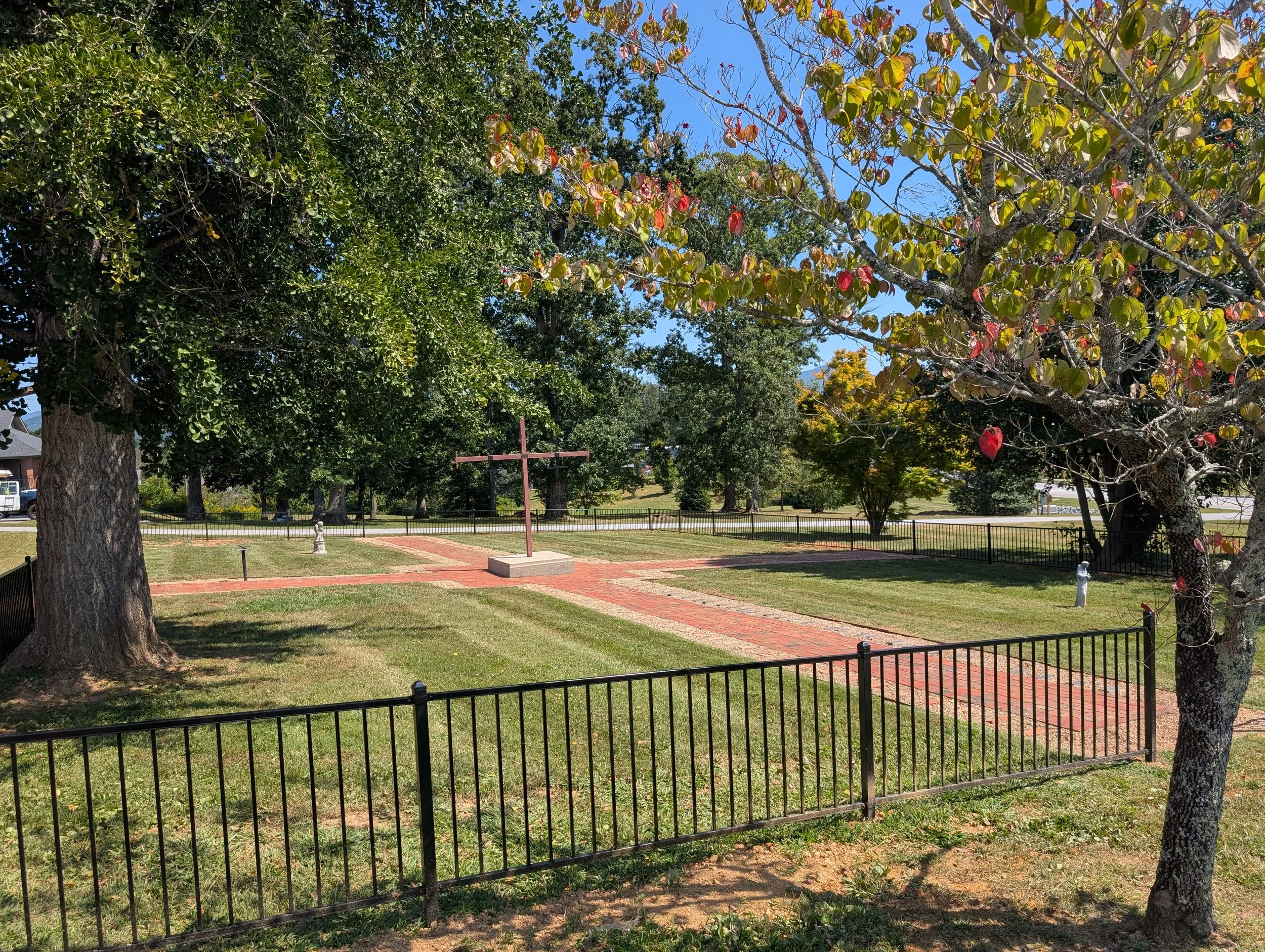
Canterbury Memorial Garden
Whether you seek a quiet moment for personal prayer, a meditative walk in the labyrinth, or a serene outdoor spot to rest in God's presence, we invite you to visit, walk, and experience the renewed peace of these sacred grounds.
* * *
Calvary Churchyard became a place of burial sometime during the 1800s. The oldest extant grave marker dates to the late 1860s, but there are many unmarked graves in the Old Section that are probably years older.
The names of many prominent families of the area can be read on the stones which stand as a silent congregation under the arch of the venerable trees — Blake, Weston, Fletcher, Westfeldt, Presley (and Pressley), Shuford, Cecil, Owen, Clark, Givens, Seely, Grove – the names of community leaders that span the western North Carolina mountains. An opera singer, a 19th century humorist, a bishop, priests, doctors, politicians, teachers, attorneys, many children, Russian royalty, a punk-rocker, housewives, farmers, soldiers, all sorts and conditions of people, some rich in things, many rich in spirit, people known and unknown, are part of this larger congregation.
* * *
Many stories and legends have grown up around the Churchyard.
“The Headless Horseman”
As it is with most folktales, they are embellished with each telling of the story to the “younger folk” by the oldest member of the community as they sit huddled around a fireplace trying to stay the winter’s numbness just outside the old, drafty log walls of the cabin. Or one may hear the story as “grandpa” entertains all who will sit and listen, astraddle a log on the woodpile on a summer evening—the labors of the day ended and an hour or so to be spent until the moon rises and the bed offers rest and sleep. I have heard this story told by several “old-timers,” each of whom would vow by all that’s holy that they have seen this specter riding, and several times a narrator claims to have had this “horseman” ride by like the wind and not more than an “arm’s-length” away.
Around Calvary Church, back in the days of “the war,” the Churchyard to the south and west of the Church was covered with great oak and pine trees. All brush and briars were kept grubbed out, and a thick layer of leaves and needles covered the ground. To the north of the Church spread the old graveyard with its mounds, stones, and flowering shrubs. No one dared walk the paths between the graves after dark, for spirits and ghosts were abroad each night. But the open woods to the south of the old bell tower made an excellent place to camp and drill.
Now the story goes that a call had gone out, by word of mouth, to the coves and valleys of these mountains for volunteers to fight for the South. From the mountainsides and from the coves came mountain men and boys carrying what provisions they could and their own “hunting guns.” They came from far and wide to Calvary Church, and there under the trees they would camp and drill until a company large enough and ready would march off together to the war. An old thorn hedge surrounded the Church grounds with two or three openings for the “Church people” to drive their carriages up to the Church for “Church meetings” on Sundays.
These “volunteers” camping under the trees felt comparatively safe—with a graveyard on one side and a high, thick thorn hedge on the other. But the roads going through the hedge required sentries at night, so three men at a time would take their turns standing guard.
Now there lived nearby several “Yankee” families who had more recently moved here from “up north.” These “furriners” were never trusted; in fact, they were suspected of being spies—gathering whatever information they could about the South and sending it up north by secret riders at night.
Guards were necessary to keep such spies away from the Churchyard. Now these guards and those getting ready to fight in the Army were always cautioned to remember they were in a Churchyard and there must be no rowdiness, bad talk, or bloodshed in this sacred spot, this order to be carried out on pain of dismissal from the company.
One night, toward midnight, one of the sentries standing guard at the “back road” thought he heard some movement in the leaves outside the hedge. There was little light; the new moon broke through the heavy clouds for a moment or two only once in a while. He was all attention, quietly listening for any intruder to come in, hoping that the moon would come out even for a few minutes. This guard knew about the “foreign families” nearby, and right now he was sure one of them was on the outside of the hedge trying to find a hole he could look through and count how many would be leaving the next day for the fighting in Virginia.
A twig breaking, the moon shining through the clouds just for a moment shows a young man’s head poking through the hedge just a few feet away. A shot would cause a great commotion, so quietly a sword was drawn, and with one stroke the protruding head rolled on the ground. Without any cry or sound, the headless body jumped up, ran a few yards into the woods, and, leaping onto a great white horse, raced off to the south down an old road leading past “Old Salem” meeting house and then on down Cane Creek Valley.
This sentry felt he had done his job well and would be commended for his night’s work, until he suddenly remembered the definite warning—“not to shed any blood on this sacred ground.” The little blood beside the hedge could be covered up, but what about the head still lying there on the leaves? Where could he hide this evidence? Panic seized him. Taking the head by the hair, he stole silently up to the old well in the rear of the Church and dropped it in. After hearing it splash in the water sixty feet down, he went back to his sentry post and said nothing about the whole incident. The company of recruits left the next day for battle.
Now there was no funeral for the headless body, for a burial would have told all the neighbors that the mourning family were spies. So nothing was done about the whole affair. But to this day there are those who will swear that about the middle of the summer, when the moon is new and the sky is filled with racing thunderclouds, up the ravine by the place where a few moss-covered headstones mark the spot where “Old Salem” meeting house stood, will come a headless horseman—riding like the wind on a great white mare, riding up to the place where the old thorn hedge once stood. After searching for a while, they say, for the head he lost there, he will turn and ride back to the south and disappear into the mists rising from the drowsy creek—not to be seen again for another year, when this “headless horseman” will come searching again for his lost head.
“The Gentle Woman of the Mists of Calvary Churchyard”
There is another folktale, its setting in the tree-shadowed lawns of Calvary Church. It is a tale usually heard from the wrinkled lips of a local “granny” as she sits and rocks on her little porch. The story most often begins on a warm summer evening just as the moon tops Bearwallow Mountain and casts the first shadows from the old “gardenia rose” arbor—enough light, enough darkness, enough mists rising from the lawn and garden so that anyone with a bit of poetry and imagination in them might see for themselves, at that very moment, the figure of the lovely lady in white as she hastens down the paths and across the lawns of Calvary Churchyard.
Or the inspiration for this story’s retelling might be the soft words and shy glances of the young: as the moonlight and their nearness to each other proclaim it to be the rising mists or new young love, the thoughts of the storyteller will retrace their steps in time and bring forth the words:
“Now when I was a young girl, a long time ago, I saw the beautiful woman in white on a night just like this. I have seen her many times since then, and she is always the same—very beautiful and young. Oh, I would say she was twenty-one or thereabouts. She has long blonde hair and is always dressed in a soft, white, silken dress and veil that makes her blend in with the wisps of fog that drift under the trees, just as the fog is drifting tonight.”
This tall, beautiful girl seems to always be in a hurry, as though she were searching for someone and had little time to find them. Traps have been laid to catch her, but she never appears when there are those about intent on getting too close. She has never been known to harm anyone; rather, there are children who vow that when they were lost on the paths winding through the Churchyard in the gathering darkness of night, seeming to go in circles, afraid and crying, they would suddenly see the woman in white by their side leading them toward home, and on reaching the boundary of the Churchyard, she would suddenly disappear.
A few of the very old who tell this story say she was the betrothed of a handsome young man—both the only children of their families and living on neighboring plantations. As he walked a woodland path one night between their homes—he on his way to see her and vow his love anew, she waiting to tell him of her latest plans for their coming wedding—she waited until late into the night. He never arrived, disappearing forever somewhere near old Calvary Church. Soon she died of a broken heart, and ever since, on certain nights, she goes in search of her lover and a renewal of their happiness together. Others say they have seen this romantic lover in a frock coat and wing collar walk the same paths just ahead of his searching fiancée, and always just out of her sight.
There is no mistaking the proud and aristocratic figure moving in stately dignity, and yet in haste, among the shadows and floating mists of the old churchyard. To see her is to admire her beauty and forever after carry a warm feeling of pity and love, mixed together, for this princess of the mists, forever doomed to search for love and happiness.
“Phantom Rider of the Confederacy”
This church is located in the town of Fletcher, and while the building itself is not supposed to be haunted, it is the location of a North Carolina legend. The Phantom Rider of the Confederacy is a legend that dates back to the American Civil War. It surrounds a young woman whose husband was killed in the war and who died soon after, vowing revenge on those responsible for her husband’s death. She has reputedly been spotted many times riding on horseback in the area of the church, and this continues to be reported to this day.
One story surrounding her reports that she was spotted by Confederate soldiers while the war was still ongoing. When they followed her, they were lured into a Union ambush, and many were killed, with the woman suddenly disappearing just before the ambush took place. While trying to find her to punish her, Confederate soldiers were said to have spotted her a few times, although when they fired upon her, the bullets passed through rather than hitting her. The legend of the Phantom Rider of the Confederacy has long been folklore in North Carolina, and a trip to the Calvary Episcopal Church may enable you to see her riding past.


As a fourth generation member of Calvary, I have many relatives buried in our beautiful historic churchyard. It has always brought me comfort to know that my family members were laid to rest on this sacred ground and so close TO the church that meant so much to them.
- Suzanne Nesbitt Dawkins